Bass Fishing Tackle: Rods, Reels, and Lures Buying Guide
By Mark Ellison · Published · 5 min read
Bass fishing rewards versatility more than almost any other freshwater pursuit. You might pitch a jig into flooded timber in the morning, burn a spinnerbait along a weed edge at noon, and drag a football jig over a rocky point before dark. The tackle that handles all three without wearing you out is the tackle worth buying.
This guide breaks down rods, reels, and lures by budget and technique, with the numbers that actually matter: length, power, action, gear ratio, line capacity, and lure weight ranges. Whether you are assembling a first setup or filling a gap in a crowded rod locker, the goal is the same: spend where it changes your fishing, save where it does not.
Rods: Length, Power, and Action in Plain Terms
Length controls leverage and casting distance. For most bass fishing from a boat or bank, 6'6" to 7'2" covers the widest range of techniques. Shorter rods (6'0" to 6'6") cast accurately around docks and overhanging cover; longer rods (7'0" to 7'6") cast farther, pick up line faster on hooksets, and handle heavier lures with less effort.
Power describes how much force it takes to bend the rod and roughly matches lure and line weight. Ultralight through medium-light suits finesse presentations and treble-hook lures; medium is the all-around workhorse; medium-heavy and heavy handle jigs, Texas rigs, and flipping into cover. Action describes where the rod bends: fast and extra-fast tips bend mostly near the top, giving quick hooksets and crisp lure control.
For a first or only bass rod, a 7'0" medium-heavy, fast-action casting rod rated roughly 1/4 to 1 oz is hard to beat. It throws Texas rigs, jigs, spinnerbaits, and most crankbaits in the 3/8 to 3/4 oz range. If you fish smaller waters or mostly weightless plastics, a 6'10" medium-light spinning rod is more pleasant. Our guide on choosing your first fishing rod walks through these trade-offs in more depth.
- 6'6"–7'0" medium-heavy, fast: best single do-everything casting rod
- 6'10"–7'2" medium spinning: finesse, weightless plastics, lighter line
- 7'3"–7'6" heavy, fast: flipping, pitching, and heavy cover
- 7'0"–7'6" medium, moderate-fast: crankbaits and treble-hook lures
Reels: Gear Ratio, Drag, and Line Capacity
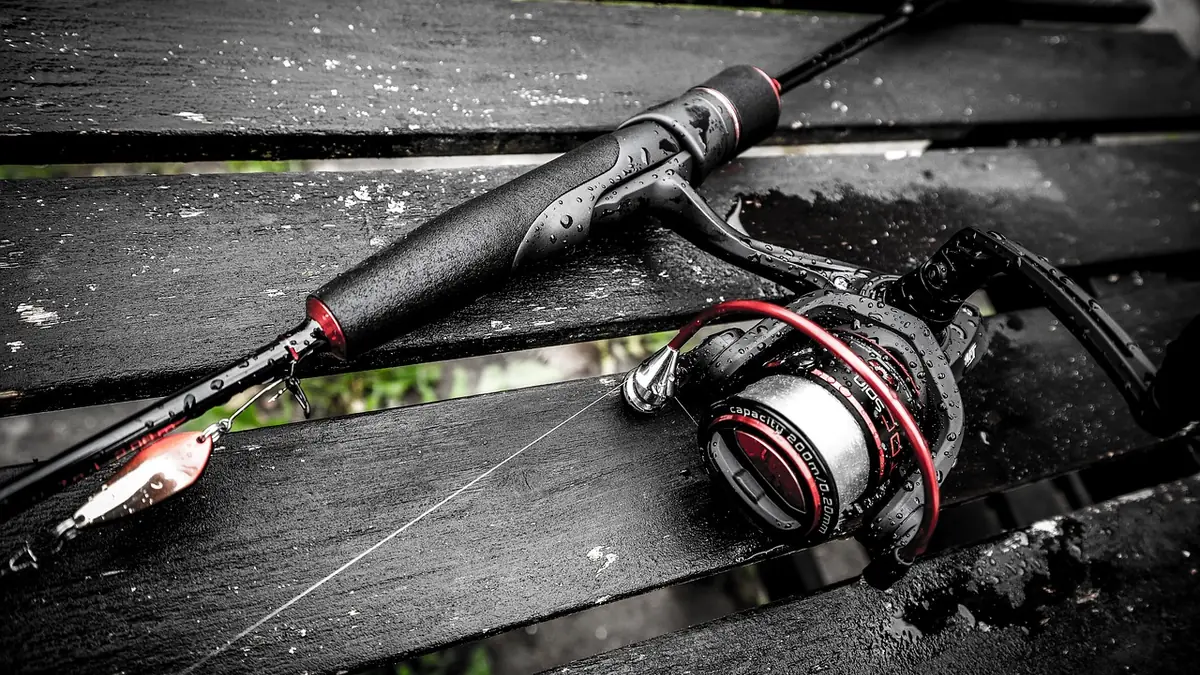
Baitcasting reels dominate power fishing because they handle heavier line and lures with better control. Gear ratio sets how fast you retrieve: 6.2:1 to 7.3:1 is a versatile middle ground, 8.0:1 and faster suits flipping and burning lures, and 5.3:1 to 6.2:1 helps with deep crankbaits where you want slow, steady grind. Drag in the 10–15 lb range is plenty for bass; more matters mainly with heavy cover and braided line.
Spinning reels shine for finesse: drop shots, shakey heads, small jerkbaits, and anything thrown on 6–10 lb line. A 2500-size reel with a 5.2:1 to 6.2:1 ratio and 8–12 lb drag covers most freshwater bass needs. Line capacity is worth checking: a 2500 spool typically holds around 140–200 yards of 8 lb mono, which is far more than a bass will take but leaves margin for respooling.
Budget matters less than smooth drag and a reliable anti-reverse. Reels in the $60–$120 range have improved enormously; a $100 baitcaster with a solid braking system will outfish a neglected $250 reel. Spend up if you fish heavy cover often or want a reel that survives years of weekend use.
- Baitcaster 6.2:1–7.3:1: all-around ratio for jigs, plastics, spinnerbaits
- Baitcaster 8.0:1+: flipping, pitching, fast topwater
- Spinning 2500 size: finesse, 6–10 lb line, drop shot and shakey head
- Check drag smoothness and anti-reverse before brand or price
Lures by Season and Cover
Lure selection follows water temperature and cover. In early spring, when water is in the high 40s to mid 50s, bass often stage on points and secondary banks. Slow down with a suspending jerkbait, a lipless crankbait, or a jig dragged slowly along the bottom. As water warms into the 60s, spinnerbaits, chatterbaits, and squarebill crankbaits become effective around shallow cover.
Summer patterns split between deep structure and shallow shade. A Texas-rigged worm or football jig worked on offshore humps and ledges produces when fish suspend; a frog or buzzbait over matted vegetation works early and late. In fall, bass feed heavily on shad, so crankbaits, swimbaits, and spinnerbaits in shad patterns cover water fast. Winter means finesse: small jigs, drop shots, and blade baits fished slowly.
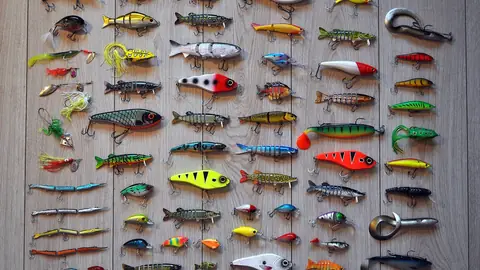
Color is simpler than the tackle aisle suggests: match forage most of the time, then switch to darker colors in stained water and brighter or translucent colors in clear water. Carry a small, focused box rather than dozens of baits you never tie on.
- Cold water (under 55°F): jerkbaits, lipless cranks, finesse jigs, drop shot
- Warming water (55–70°F): spinnerbaits, squarebills, Texas rigs, chatterbaits
- Summer: frogs and buzzbaits shallow; football jigs and deep cranks offshore
- Fall: shad-pattern crankbaits, swimbaits, and spinnerbaits
- Stained water: darker colors; clear water: natural and translucent
| Setup | Rod | Reel | Line | Best For | Approx. Cost |
|---|---|---|---|---|---|
| Entry all-around | 7'0" medium-heavy, fast casting | Baitcaster 6.4:1 | 12–15 lb fluorocarbon | Texas rigs, jigs, spinnerbaits | $120–$200 |
| Finesse spinning | 6'10" medium-light, fast spinning | 2500 spinning 6.0:1 | 8–10 lb fluorocarbon or braid + leader | Drop shot, shakey head, small jerkbaits | $100–$180 |
| Crankbait rod | 7'0"–7'6" medium, moderate-fast | Baitcaster 5.3:1–6.2:1 | 10–12 lb mono or fluoro | Squarebills, deep cranks | $150–$300 |
| Heavy cover | 7'3"–7'6" heavy, fast | Baitcaster 8.0:1+ | 50 lb braid | Flipping, pitching, frogs | $200–$400 |
| Mid-range do-all | 7'0"–7'2" medium-heavy, fast | Baitcaster 7.1:1 with good braking | 12–15 lb fluorocarbon | Jigs, plastics, chatterbaits | $300–$450 |
Line and Leader Choices
Bass tackle works best when line matches the technique. Monofilament is forgiving, inexpensive, and stretches, which helps with treble-hook lures and crankbaits but hurts hooksets on long casts. Fluorocarbon sinks, is more abrasion-resistant, and is less visible, making it a good fit for bottom contact and clear water. Braid has almost no stretch, casts far, and cuts through vegetation, but needs a leader in clear water and requires a forgiving rod tip.
Typical ranges: 8–12 lb mono for cranking and topwater, 10–15 lb fluorocarbon for Texas rigs and jigs, 30–50 lb braid for flipping and frogs. If you are still sorting out which line to use where, our comparison of monofilament, fluorocarbon, and braid explains the trade-offs in detail.
Budget Builds: Where to Spend and Save
A practical entry setup runs roughly $120–$200 total: a $50–$80 medium-heavy casting rod, a $50–$80 baitcaster or 2500 spinning reel, and $20–$30 of line. This covers Texas rigs, spinnerbaits, and simple crankbaits. Upgrade the rod first if you can; a better rod improves feel and hooksets more than a better reel does at this level.
A mid-range setup of $300–$450 buys a rod with better sensitivity and a reel with smoother drag and braking. That is the sweet spot for anglers fishing 30 or more days a year. Above that, returns diminish quickly unless you are chasing tournament-level performance or fishing very heavy cover regularly.
Do not forget care. Reels need rinsing after salt or muddy water and occasional lubrication; rods need storage away from heat and pressure points. Our seasonal maintenance schedule and off-season rod storage guide cover the routines that keep tackle working.
Boat, Bank, or Kayak: Matching Tackle to Access
Where you fish shapes what you carry. Boat anglers can bring several rods and a full box; bank anglers do better with one spinning outfit and a small selection of soft plastics and crankbaits that cast well from awkward angles. Kayak anglers need short handles, leashes, and gear that stows easily; a 7'6" rod can be awkward on a crowded deck.
If you are still deciding on a platform, our comparisons of sit-on-top versus sit-in kayaks for fishing and canoe versus kayak for beginners are useful starting points. The tackle principles stay the same; only the rod length and storage constraints change.
- A 7'0" medium-heavy fast casting rod is the most versatile single bass rod for most anglers.
- Match line to technique: mono for treble hooks, fluorocarbon for bottom contact, braid for cover.
- Spend first on the rod, then the reel; a smooth drag matters more than a high price tag.
- Carry a focused lure selection by season and water clarity instead of a giant box.
Mark has spent years fishing and paddling across rivers and lakes, testing gear in real conditions. He focuses on practical buying advice for beginners and occasional anglers. His goal is to help readers avoid overspending and choose equipment that fits their actual use.